Blog
Does Pinterest Label AI-Generated Pins? (2026)
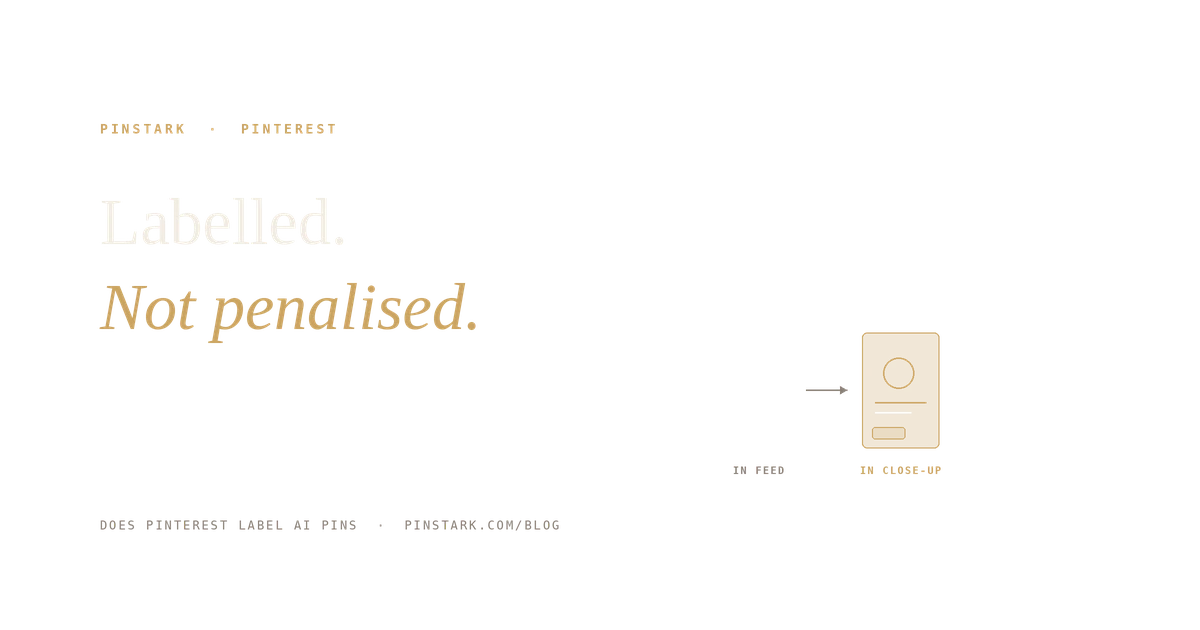
Yes. Pinterest labels Pins it believes were generated or modified with AI, and it detects them two ways — through the metadata attached to the file, and through classifiers that work even when there is no metadata to read. But the label is smaller and better placed than most people assume, and the thing that actually affects your reach is a different feature entirely.
Here is what Pinterest's own documentation says, what it carefully does not say, and what it means if you publish AI-generated product imagery.
Where the label actually appears
This is the detail that changes the whole picture, and almost every article about it gets it wrong.
Pinterest's help documentation states that when its system detects AI generation or modification on a Pin that is not promoted, "you'll see an AI modified label in close-up at the bottom left after you click on the Pin."
In close-up. After you click.
The label is not on the tile in the home feed. It is not on the tile in search results. A person scrolling past your Pin does not see it. They see it only once they have already tapped through — at which point they are on your Pin, reading your description, and the pin has already done its job of earning attention.
For promoted Pins the placement differs: the disclosure sits behind the ellipsis menu alongside the other ad details, rather than appearing on click-through.
There is also an appeals process. If a Pin is labelled and you believe it should not be, Pinterest's help page points to a route for contesting it.
How Pinterest detects it
Two mechanisms, and the second one is the reason stripping metadata does not work.
The first is metadata. Pinterest reads the provenance information embedded in image files by the tools that made them, which is how most generated images announce themselves.
The second is classification. In Pinterest's words, it has "developed classifiers that automatically detect Gen AI content, even if the content doesn't have obvious markers."
That second sentence is worth sitting with if you have been advised to scrub EXIF data before uploading. Pinterest says plainly that it detects generated content without relying on markers. Removing metadata is not a strategy, and a Pin that is labelled anyway after you tried to hide it is not a better outcome than one labelled honestly.
You can also declare it yourself. Pinterest applies the label when "the content owner indicated that the Pin was generated or modified using AI."
What Pinterest does not say
Being precise about silence matters more here than anywhere, because the gap between what the documentation says and what people assume it says is where bad advice lives.
Pinterest's published material does not say that AI-generated Pins are banned. It does not say they are removed. It does not say they are demoted, down-ranked or suppressed in search. The documentation describes labelling, not penalising.
What it does say is that the community guidelines "apply to all content on Pinterest, regardless of how it has been created" — the same standards, not a harsher set.
It is also worth knowing that Pinterest itself builds with generative AI. Its Pinterest Canvas model family, trained on more than 600 million data points, powers image enhancement on the platform, and Pinterest uses generative AI to make ads more engaging. This is not a platform with an ideological objection to the technology.
Anyone telling you Pinterest punishes AI pins is adding something to the record that is not in it. Anyone telling you Pinterest fully embraces them is skipping the next section.
The part that actually affects reach
In October 2025 Pinterest launched user controls that let people "decide whether they want to see more or less GenAI content in their feed", through a settings panel headed "Choose GenAI interests you'd like to see in your recommended Pins."
The controls are per category. As of Pinterest's December 12, 2025 update, they cover architecture, art, beauty, entertainment, men's, women's and children's fashion, health, home decor, sport, and food and drink — with Pinterest stating they "will continue to roll out to more categories."
Read that list against where affiliate money is made on Pinterest. Home decor, beauty, fashion and food are not edge cases. They are the core of the platform's commercial activity.
So the honest position is this. The label itself is cosmetic and well-placed. The tuner is not cosmetic. A user who turns down generated content in home decor will see less of it in their recommendations, and if your pins are generated and that is your category, some portion of your potential audience has opted away from you.
Two caveats, both of which cut in your favour and neither of which should be oversold. Pinterest has not published how many users have changed any of these settings, so the size of the effect is unknown. And the controls are described against "recommended Pins" and "their feed" — Pinterest does not state whether they apply to search results. Pinterest is a search engine as much as a feed, and a great deal of affiliate traffic arrives through search. But Pinterest has not said search is unaffected, and we are not going to say it for them.
What to do about it
Declare it. The classifiers find generated content without metadata, so concealment buys nothing and costs you the option of appealing a label you disagree with.
Make images that would be worth saving either way. The tuner reduces generated content for people who asked for less of it. It does nothing to the people who did not. Among those, an image competes on whether it is good, exactly as before.
Generate the product rather than the listing photo. If your image is built from the product itself rather than extracted from a merchant's photograph and decorated, it is original content — which matters for the affiliate programme's own terms as much as for Pinterest. We set out why in our piece on Amazon's product photos.
Watch your category. If you are in home decor or beauty, assume some share of your recommended-feed reach is reduced and lean harder on search, keyword-led descriptions and boards people follow deliberately. Our keyword research guide covers the search side.
Do not treat a label as a penalty. It is a disclosure shown after the click. The Pins that lose are the ones nobody clicks, which has always been true.
FAQ
Will my AI pins get removed? Nothing in Pinterest's published documentation says AI-generated Pins are removed for being AI-generated. The community guidelines apply to all content equally, so a Pin removed for a guideline breach would have been removed either way.
Does the AI label hurt my click-through rate? It cannot affect the decision to click, because it is not visible until after the click. Whether it affects what someone does next is not something Pinterest publishes data on.
Can I remove the label? There is an appeals process for Pins you believe were labelled incorrectly. There is no route to opt out of accurate labelling.
Does stripping metadata work? No. Pinterest states it detects generated content through classifiers even without obvious markers.
Should I disclose AI use in my pin description? Pinterest offers a way to mark a Pin as AI-generated at the source, which is cleaner than a note in the copy. Separately, your affiliate disclosure obligations are unchanged and unrelated — the rules on affiliate links covers those.
Is any of this different for ads? Yes, in placement only. On promoted Pins the disclosure appears behind the ellipsis icon with the other ad details rather than on click-through.