Blog
How to Make Money on Pinterest: 5 Methods, Honestly Compared
There are five ways people actually earn on Pinterest: affiliate links, their own products, sponsored content, traffic to a site they own, and managing accounts for other people. They differ enormously in what you need before you start and how long you wait to see anything.
One thing is true of all five, and it shapes the rest of this page: Pinterest is a visual search engine, not a social feed. A Pin is distributed over weeks and keeps circulating for months, so every method here carries the same delay at the start — and the same durability once it passes.
At a glance
| Method | What you need first | Time to first earnings | What caps it | Ongoing work |
|---|---|---|---|---|
| Affiliate links | A program, original images | 2–6 months | Commission rate | Steady publishing |
| Your own products | Something to sell | 1–3 months | Your product range | Product + fulfilment |
| Sponsored content | An audience brands want | 6–12 months | Audience size | Pitching, deliverables |
| Traffic to a site you own | A destination that earns | 3–6 months | The destination's economics | Two channels at once |
| Services for other accounts | Provable results | 1–2 months | Hours you can bill | Client work |
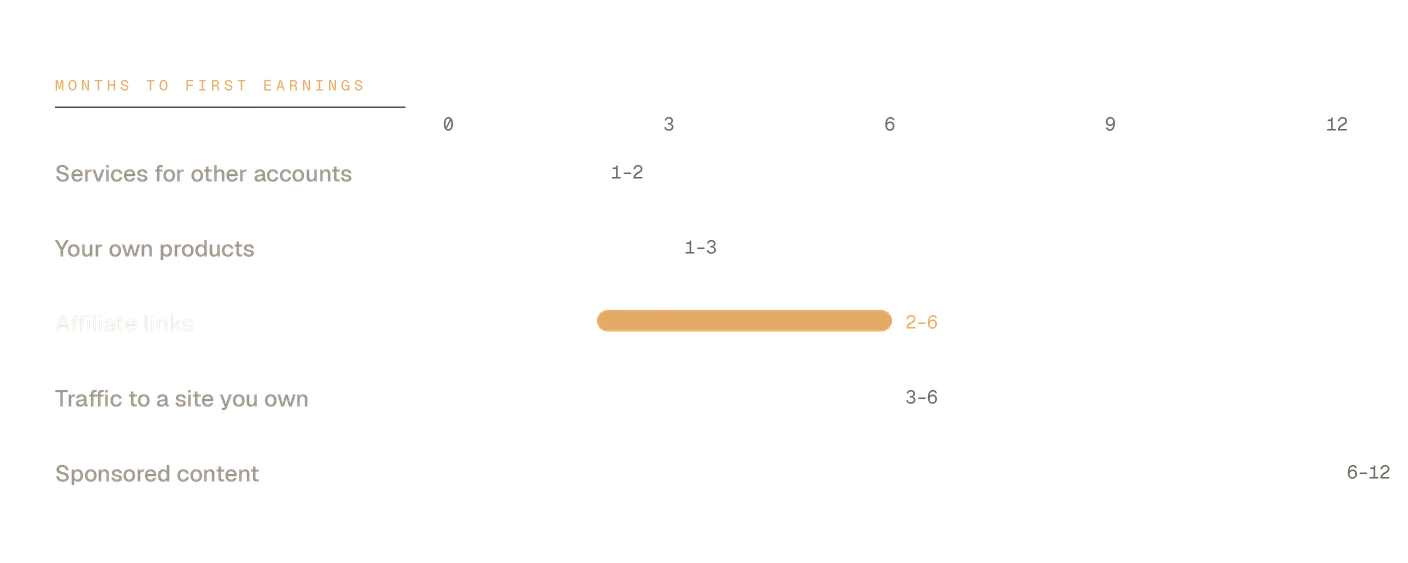
The month ranges above are estimates from how the platform behaves, not measured data — treat them as ordering rather than promises.
1. Affiliate links
You promote someone else's product and earn a percentage when a click converts. No inventory, no support, no fulfilment.
Why it fits Pinterest well. People browse Pinterest while planning a purchase rather than after deciding, which is exactly when an affiliate link is useful. The platform permits direct affiliate links, so the mechanics are simple.
The part nobody mentions. You usually can't use the merchant's photos — Amazon restricts storing its product images, and Etsy's belong to individual sellers — so you need original imagery for products you don't own, repeatedly. That constraint is what most affiliate attempts fail on, long before keywords or commission rates matter. Generating product photography from a product URL is one answer to it, and it's what Pinstark was built for.



Suits you if you don't want to build or support a product and can hold a publishing cadence for a few months. Start by checking which programs accept Pinterest affiliates, then read how Pinterest affiliate marketing actually works end to end.
2. Selling your own products
Physical goods, digital downloads, printables, templates, courses. You keep the whole margin instead of a commission.
Why it fits. Pinterest's audience arrives in planning mode, which suits anything bought deliberately. Digital products match especially well — a printable or a template is bought on much the same impulse that made someone save the Pin, with nothing to ship.
The trade. You've added a business to your marketing. Product development, customer questions, refunds and fulfilment are all yours now. The ceiling is genuinely higher than affiliate work, and so is the effort required to reach it.
Suits you if you already have something to sell, or you'd rather build an asset than rent someone else's.
3. Sponsored content and brand deals
A brand pays you to feature its product to your audience.
Why it's harder than it looks here. Brands buy audience and influence, and Pinterest makes both slower to demonstrate than Instagram or TikTok do. Your Pins can reach large numbers of people who have no idea who you are — excellent for affiliate clicks, poor for the follower relationship a sponsor is paying for.
What that means in practice. This is the slowest of the five to become viable and the most dependent on things you don't control. Most people earning this way on Pinterest built the audience somewhere else first.
Suits you if you already have a following in a niche brands want.
4. Driving traffic to something you own
Pinterest isn't the business; it's the top of the funnel. Clicks go to your blog, shop or newsletter, and the money is made there.
Why it's the most durable. You own the destination. When a program changes its terms or a platform changes its ranking, your audience is still reachable. An email list built from Pinterest traffic keeps working regardless of what Pinterest does next.
The trade. You're running two things at once — a Pinterest practice and whatever it points at — and both have to work before either pays.
Suits you if you already have, or genuinely intend to build, a site or list worth sending people to.
5. Managing Pinterest for other people
You do the work described above, for someone else's account, for a fee.
Why it's the fastest to first payment. You're selling time, not waiting on distribution. If you can show results on your own account, the first client is usually weeks away rather than months.
The ceiling. It scales with your hours until you hire, which turns it into a different kind of business. It also stacks well with the other four rather than replacing them — the account you run for yourself is the portfolio that wins the client.
Suits you if you want income sooner and will trade time for it. Accounts built as a brand rather than a person are the easiest to run this way, and the faceless playbook is how that's done.
What all five have in common
Images are the constraint, not ideas. Every method needs a steady supply of original imagery. Decide how you'll produce it before you plan anything else.
Nothing here pays in week one. Pins accumulate impressions over weeks and circulate for months. Judge results at three months, not three weeks.
Consistency beats volume. A cadence you can sustain teaches Pinterest more than an occasional burst — it's the difference between an account that compounds and one that stalls. Scheduling and keyword research are where that gets practical.
So which one?
Lowest setup cost: affiliate links. No product, no clients, no audience threshold — provided you solve the image problem first, because that's what ends most attempts.
Highest ceiling: your own products, or Pinterest feeding a site you own. Both require building something before either pays.
Money soonest: services. The only one of the five that doesn't wait on Pinterest's distribution delay.
Already have an audience: sponsored work becomes viable, and it stacks with affiliate income rather than replacing it.
FAQ
Does Pinterest pay creators directly? Pinterest has run creator monetization programs, but availability and eligibility have changed repeatedly and vary by country. None of the five methods above depends on one — which is deliberate.
How many followers do I need? None, for affiliate links, your own products or services — Pinterest distributes by search relevance rather than follower count. Sponsored work is the exception, because that's the one where a brand is buying the audience.
Which method is best for beginners? Affiliate links, for the low setup cost, provided you have a realistic answer to how you'll produce original images week after week.
How long until this replaces a job? For most people it doesn't, and treating that as the goal is how the first three months become discouraging. Pinterest income is better understood as something that accumulates alongside other work.